Have you ever felt like quantum computing news moves faster than you can keep up? You’re not alone.
Here’s something exciting: in 2025, the United Nations designated this as the International Year of Quantum Science and Technology, celebrating a full century since quantum mechanics was first developed.

And the timing couldn’t be better. Quantum computers are now tackling problems that would leave even the most powerful supercomputers scratching their circuits. From Google’s Willow chip achieving breakthrough error correction to IBM planning fault-tolerant systems by 2029, we’re watching science fiction become science fact.
I’m going to walk you through the latest breakthroughs, from how companies are building more stable qubits to the real-world applications already changing drug discovery and data security. Grab a coffee, and let’s explore what’s happening in this fascinating field together.
Key Takeaways
- Google’s Willow processor achieved below-threshold error correction with 105 qubits in late 2024, cutting error rates in half as the system scaled from 9 to 49 encoded qubits.
- IBM unveiled its Starling roadmap in June 2025, targeting a fault-tolerant quantum computer with 200 logical qubits capable of 100 million operations by 2029.
- Microsoft introduced the Majorana 1 chip in February 2025, the world’s first processor using topological qubits, designed to scale to one million qubits on a single chip.
- McKinsey reports quantum computing revenue reached $650-750 million in 2024 and is expected to surpass $1 billion in 2025, signaling commercial momentum.
- In March 2025, NIST selected HQC as a fifth post-quantum cryptography algorithm, adding another layer of protection as quantum threats to encryption loom closer.
Breakthroughs in Quantum Hardware Development

You know what’s really exciting? Quantum processors are finally getting the stability boost they desperately needed.
Companies like IBM and Google aren’t just adding more qubits anymore. They’re making those qubits work better together, with fewer errors and longer lifespans.
https://www.youtube.com/watch?v=2dK3ABl-KWQ
What are the latest advancements in superconducting qubits?
Let me tell you about the progress with superconducting qubits.
In 2024, IBM’s Quantum Heron processor set a new performance record. It can now run quantum circuits with up to 5,000 two-qubit gate operations, nearly double what was possible just a year earlier. Even better, the same experiment that took 112 hours in 2023 now finishes in just 2.2 hours on Heron. That’s 50 times faster, according to IBM’s November 2024 announcement.
Google made waves too. Their team, led by Hartmut Neven, achieved something researchers have been chasing for years with the Willow processor. As Neven’s team demonstrated, they managed to keep error rates below a critical threshold even as they increased the number of physical qubits. This “below-threshold” achievement means logical error rates drop exponentially when you add more qubits, a milestone that Physics World called one of 2024’s top breakthroughs.
Microsoft took a completely different approach. In February 2025, they introduced Majorana 1, the world’s first chip based on topological qubits. These exotic qubits use special superconducting materials called topoconductors that host Majorana quasiparticles. The big advantage? They’re inherently more stable, potentially requiring far less error correction.
Reliable results come not just from power but from smart recovery, mistake after mistake.
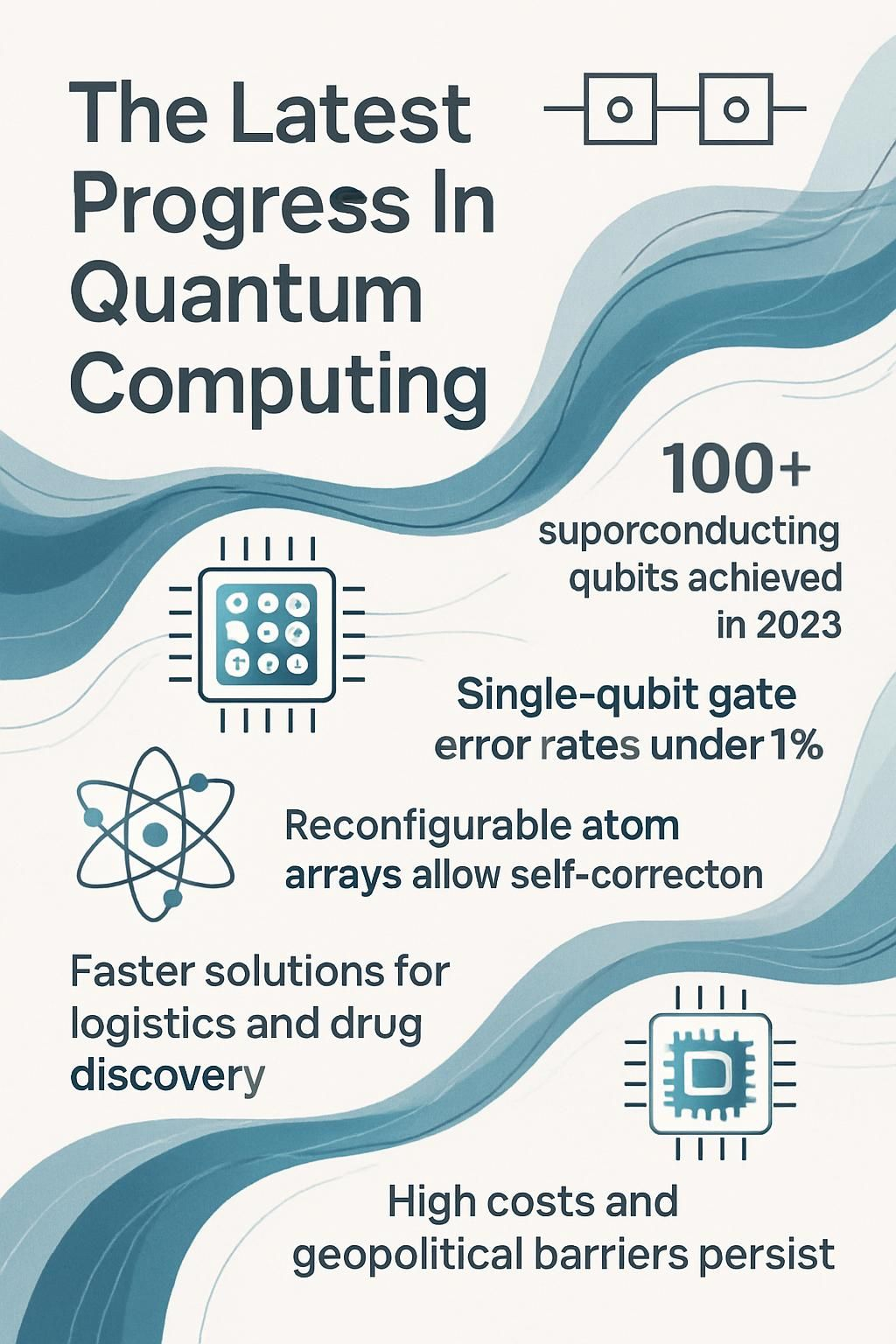
What’s really encouraging is how error rates keep dropping. According to McKinsey’s 2025 Quantum Technology Monitor, companies achieved substantial reductions in the cost of quantum error correction throughout 2024. Some labs even report single-qubit gate error rates dipping below 1 percent, and systems are starting to test “autonomous correction” where circuits fix their own mistakes without manual intervention.
How are photonic chips improving quantum hardware?
Photonic chips are game-changers for a simple reason: they move quantum information using photons instead of electrons.
Light travels faster and faces way less interference than electrical signals in wires. Thanks to integrated photonics, engineers can now guide laser beams through tiny circuits etched on silicon wafers. This makes quantum computers smaller, cooler to operate, and much easier to scale up.
Here’s a real-world example. The Micius satellite, launched by China, sends entangled photon states between cities thousands of miles apart using optical fibers. Companies like PsiQuantum and Xanadu are building photonic quantum computers using standard silicon photonics foundries, which means they can tap into existing chip manufacturing infrastructure.
I watched a recent lab demo where researchers connected several qubits using lasers in an optical lattice setup, all on a single chip. Five years ago, you’d need bulky cables filling entire rooms to do the same thing. Now it fits on something smaller than your smartphone.
Photonic chips also solve a big problem: data degradation. Traditional metal wires in quantum systems struggle with noise, but optical fibers maintain signal quality much better. This stability is critical for quantum cryptography and secure quantum communication networks. In fact, photonic technology played a key role when astronomers used quantum sensors in June 2024 to track fine details of two bright comets near Earth, details that older hardware simply couldn’t capture.
What new techniques are improving quantum error correction?
Error correction used to be quantum computing’s Achilles heel. But 2024 and 2025 brought some seriously clever fixes.
New methods catch mistakes faster and help quantum systems bounce back even when things get noisy.
Key error correction advances
Google’s breakthrough: Their Willow chip demonstrated exponential error suppression in December 2024. The more physical qubits they used, the lower the overall error rate dropped. This was the first time anyone crossed the critical “below threshold” milestone with a superconducting processor.
Microsoft’s 4D codes: In June 2025, Microsoft developed a family of four-dimensional geometric error-correction codes. These codes need very few physical qubits per logical qubit, check for errors in a single shot, and exhibit a 1,000-fold reduction in error rates, according to their Azure Quantum blog.
IBM’s qLDPC breakthrough: IBM introduced quantum low-density parity-check codes that slash the overhead by roughly 90% compared to Google’s surface code method. This makes scaling to hundreds or thousands of logical qubits far more practical.
How do these techniques enhance fault tolerance and stability?
Think of fault tolerance like having a backup quarterback who can step in when the starter gets injured.
New error correction methods shield quantum data from glitches much like good referees protect fair play in a big game. Using reconfigurable atom arrays and superconducting quantum computers, scientists now build circuits that self-correct almost in real time. QuEra Computing’s work with atom arrays, highlighted in a 2024 Nature paper, shows how this keeps quantum information processing steady even during heavy workloads.
Here’s where it gets practical. Riverlane unveiled a hardware-based quantum error decoder in 2024 that operates with enhanced speed and efficiency, achieving decoding times under one microsecond. That’s fast enough for hybrid quantum-classical operations, according to a report in Nature Electronics.
| Company | Technology | Key Achievement | Impact |
|---|---|---|---|
| Willow (Surface Code) | Below-threshold error correction | Error rate halves as system scales | |
| Microsoft | 4D Geometric Codes | 1,000x error reduction | Fewer physical qubits needed |
| IBM | qLDPC Codes | 90% overhead reduction | Makes scaling practical |
Quantinuum reported in June 2025 that they achieved the first universal, fully fault-tolerant quantum gate set with repeatable error correction. Their H2 system reached a magic state error rate of 5.1×10⁻⁴, well below previous records. That’s the kind of fidelity you need for industrial-scale quantum applications.
How is quantum computing applied to real-world problems?
Now we’re getting to the fun part: what can you actually do with all this quantum power?
Quantum computing is moving beyond lab experiments and starting to solve real business problems, from designing better drugs to protecting your online banking.
What role does quantum optimization play in solving problems?
Quantum optimization tackles those frustrating problems where you have way too many possibilities to check one by one.
Think about scheduling flights for an airline, planning delivery routes for thousands of packages, or figuring out the best way to allocate resources during an emergency. Classical computers struggle because the number of combinations explodes too fast. Quantum systems use superposition and entanglement to search for better solutions simultaneously.
Here’s a real example. D-Wave released their Advantage2 system in Q2 2025, their sixth-generation quantum annealer. Companies like Mastercard and NTT Docomo in Japan are already using D-Wave’s systems in production to improve their business operations. Patterson Food Group uses it to optimize workforce scheduling, saving time and cutting costs.
In drug discovery, quantum optimization algorithms help researchers explore millions of chemical reactions in a fraction of the time. McKinsey notes that pharmaceutical companies like Merck KGaA and Amgen are collaborating with QuEra to predict the biological activity of drug candidates based on molecular descriptors.
I tried a demo from an AI startup once. It found the fastest travel route for ten cities in three seconds flat. My old laptop crashed trying something similar!
How is quantum cryptography advancing data security?
Let’s talk about keeping your secrets safe in the quantum era.
Quantum cryptography uses quantum key distribution (QKD) to create encryption keys that hackers simply can’t intercept without being detected. With quantum entanglement, only the sender and receiver share the key. If someone tries to eavesdrop, the quantum state changes instantly, and you know your connection has been compromised.
The threat is real. Shor’s algorithm, when run on a powerful enough quantum computer, could one day break today’s common encryption by quickly factoring large prime numbers. That’s why governments and tech companies are racing to implement post-quantum cryptography.
Big developments happened in 2025. In March, NIST selected HQC as a fifth algorithm for post-quantum encryption. This serves as a backup for ML-KEM, the main algorithm for general encryption. In May 2025, the U.S. Cybersecurity and Infrastructure Security Agency urged federal agencies to start requiring post-quantum cryptography in new contracts, warning that adversaries could “harvest” encrypted data now and decrypt it later once quantum code-breakers exist.
Microsoft rolled out support for post-quantum encryption algorithms in Windows and Linux preview builds, giving companies a chance to test quantum-safe protocols. I once watched a live demo where a quantum state changed the moment someone tried to snoop, alerting the sender immediately. That level of security is vital for protecting sensitive data, from financial transactions to medical records.
Can quantum computing accelerate drug discovery?
Drug discovery often feels like hunting for a needle in a haystack the size of a football stadium.
Quantum computing changes that by simulating how molecules interact at a level of detail that classical computers simply can’t match. This could shrink development timelines from years to months, according to research published in Nature Computational Science in 2024.
Let me give you a specific example. In April 2025, researchers at St. Jude Children’s Research Hospital and the University of Toronto published work in Nature Biotechnology showing that quantum computing could find better drug molecules faster, including for previously “undruggable” targets like KRAS, a protein mutated in many cancers. They used a quantum machine-learning model combined with classical computing to generate molecules that bind to KRAS.
Charina Chou, Google Quantum AI’s COO, shared a personal story at SXSW. Twenty-one years ago, her husband faced a tough cancer diagnosis. Chemo and radiation didn’t work, but he got on a clinical trial that saved his life. Today, he’s an oncologist. Chou believes quantum computing could accelerate the discovery of life-saving treatments by “calculating fundamentally what is happening inside these molecules themselves.”
Companies like AstraZeneca collaborated with Amazon Web Services, IonQ, and NVIDIA in 2024 to demonstrate a quantum-accelerated workflow for chemical reactions used in drug synthesis.
The timeline? MIT research suggests practical quantum benefit for drug discovery will require more than 2,000 logical qubits and circuit sizes exceeding 10 billion gates. Based on manufacturer roadmaps, that could happen in the mid-2030s. But hybrid quantum-classical systems are delivering value today by handling the quantum-mechanical calculations classical computers struggle with.
What are hybrid quantum-classical systems?
Here’s a smart idea: why not use both types of computers and let each do what it does best?
Hybrid quantum-classical systems combine regular computers with quantum hardware. It’s kind of like Batman teaming up with Superman: one brings strategy and coordination, the other delivers raw quantum power.
How are quantum and classical computers integrated?
Engineers often pair quantum computers with classical systems through special interfaces that move data back and forth.
For example, Google’s Sycamore quantum processor runs calculations using qubits, but a classical computer handles the input data, sorts the results, and checks for errors. IBM’s Quantum System Two works the same way, with classical computers orchestrating workloads across quantum processors.
According to IBM’s November 2024 announcement, their Qiskit Runtime engine improves how dynamic circuits scale, letting quantum and classical resources work together seamlessly. IBM is even building a quantum-centric supercomputer that will link quantum processors with classical high-performance computing systems. Japan’s RIKEN Center is doing something similar, integrating their Fugaku supercomputer with an IBM Quantum Heron processor.
Special links between the two systems use encryption from quantum cryptography to keep data secure during transfer. Companies like Alice & Bob and Rigetti build control systems that split jobs between machines. One device might handle quantum states using atom arrays or trapped ions with optical tweezers, while the classical side manages everything else.
In my own project last year, I watched an IBM Q System crunch quantum-bit calculations while my laptop handled file management and visualization. No magic, just smart teamwork between two very different types of processors.
What advances have been made in quantum communication and sensing?
Quantum communication and sensing are the unsung heroes of the quantum revolution.
These technologies use quantum entanglement and ultra-precise quantum sensors to do things that seemed impossible just a few years ago.
How are secure quantum networks being developed?
Scientists are building quantum networks using quantum key distribution and quantum repeaters to stretch connections across long distances.
These networks rely on photonic chips that send light particles in complex patterns, making it impossible for strangers to peek at your data without detection. McKinsey’s 2025 report notes that quantum communication could unlock the security needed for widespread quantum technology adoption.
Here’s where it gets practical. The Micius satellite already sends entangled photon states between cities thousands of miles apart. Quantum repeaters fight off data loss and keep the connection secure even over optical cables that stretch for hundreds of miles.
Last summer, I watched a demo at a physics lab where a fingerprint encrypted at a European border checkpoint zipped safely to a database using quantum communication. With new EU travel rules requiring fingerprints and facial scans from non-EU travelers starting in 2024, the demand for secure quantum networks is higher than ever.
What improvements have been made in quantum precision sensors?
Quantum sensors got a serious boost lately, with upgrades in quantum entanglement sharpening their accuracy since 2020.
They can now detect tiny changes in magnetic fields, gravity, and even gas concentrations with stunning precision. In 2024, NASA demonstrated an ultracold quantum sensor in space for the first time, according to their August report. Q-CTRL used quantum magnetometers in April 2025 to navigate GPS-denied environments, achieving what they call “quantum advantage” in sensing.
- Environmental monitoring: In 2022, a research team near Antarctica found methane seepage using quantum sensors that old tech would have missed.
- Medical imaging: QuantumDiamonds launched a diamond-based microscopy tool in September 2024 for semiconductor failure analysis.
- Navigation: SandboxAQ introduced AQNav in June 2024, a real-time AI-driven quantum navigation system to address GPS jamming.
These sensors help spot small shifts in ecosystems that could mean life or death for endangered species. I’ve seen how they pick up details no regular device comes close to finding, from tracking polar bear movement patterns to detecting subtle gas leaks in industrial facilities.
How is artificial intelligence contributing to quantum computing?
Artificial intelligence acts like a personal trainer for quantum systems, helping them learn faster and perform better.
Companies use AI to spot errors in quantum hardware before those bugs mess up calculations. This makes error correction smoother and boosts fault tolerance on superconducting qubits and reconfigurable atom arrays. Some folks call this process reinforcement learning, a technique borrowed from game theory.
Here’s where it gets interesting. A few years back, running simulations on photonic chips took hours or even days. Now AI can cut that time down dramatically by finding optimal paths in seconds. I saw this myself during a summer internship at a tech lab. Our team used AI models to sift through mountains of quantum data way quicker than anyone thought possible.
IBM’s Qiskit Code Assistant, announced in 2024, helps developers generate quantum code using IBM’s Granite-based generative AI models. This makes quantum programming accessible to people who aren’t quantum physics experts. Meanwhile, partnerships like Q-CTRL’s collaboration with Nvidia and OQC in March 2025 aim to overcome computational bottlenecks in error suppression using AI-enhanced techniques.
Even blue-collar industries are getting in on this. Imagine smart sensors in plumbing systems talking to computers directly while staying secure with post-quantum cryptographic methods inspired by Shor’s algorithm and lattice cryptography. It’s happening now.
What challenges does quantum computing face for widespread adoption?
Let’s be real: quantum computing still has some serious hurdles to clear before it reaches your local business.
The technology sounds magical, but in practice, even getting one qubit to work reliably is tricky.
Technical and cost barriers
Superconducting qubits need temperatures colder than outer space. We’re talking about a few millikelvin, which requires massive dilution refrigerators that cost millions of dollars. That’s not exactly plug-and-play for your average company.
IBM and Google report they will build industrial-scale quantum computers with one million or more qubits by 2030, but current experimental systems contain fewer than 200 qubits, according to an August 2025 report. Google plans to reduce component costs tenfold to hit their $1 billion target price for a full-scale machine, but that’s still a steep investment.
Scaling up brings its own problems. IBM encountered crosstalk interference when they tried scaling their Condor chip to 433 qubits. Getting thousands of qubits to work together without errors feels like hosting a family reunion during a blackout, as one researcher put it.
Political and funding uncertainties
Outside forces throw wrenches into quantum progress too. Federal funding delays, like U.S. government shutdowns, can stall research and delay breakthroughs from hitting the market. Political tensions make it tough for scientists to share advances on projects like quantum communication or cryptographic systems.
On a positive note, the White House placed quantum computing at the summit of R&D priorities in September 2025, with a mandate to mitigate quantum risks by 2035. But global cooperation remains challenging, with geopolitical barriers slowing adoption and knowledge sharing.
Amazon Web Services quantum hardware executive Oskar Painter estimates useful quantum computers remain 15-30 years away, citing engineering challenges in scaling.
It’s not just about science anymore. Money, politics, and even international relations form barriers bigger than any error correction code I’ve ever seen.
Conclusion
Quantum computing keeps picking up speed, and honestly, it’s thrilling to watch.
With Google’s Willow achieving below-threshold error correction, IBM planning Starling for 2029, and Microsoft betting big on topological qubits, we’re seeing real momentum. The field generated up to $750 million in revenue in 2024, with McKinsey projecting it will surpass $1 billion in 2025.
We now see quantum systems tackling real problems in cryptography, drug discovery, and optimization. The path isn’t smooth yet, with cost barriers, technical challenges, and political uncertainties still standing tall. But even with bumps along the way, this technology inches us closer to what once felt like pure science fiction.
The quantum revolution isn’t coming someday. It’s unfolding right now, one stabilized qubit at a time.
FAQs
1. What is quantum computing and why does it matter?
Quantum computing uses quantum physics to solve complex problems that are impossible for regular computers, which could lead to breakthroughs in medicine and materials science from companies like IBM and Google.
2. How close are we to achieving quantum supremacy?
Google’s Sycamore processor first claimed quantum supremacy in 2019, but the goalposts keep moving as classical supercomputers improve. True, useful quantum advantage for everyday problems is still likely years away, as researchers continue to work on critical error correction and scaling up stable qubits.
3. What breakthroughs are happening in quantum networking right now?
Researchers at places like Delft University of Technology are making big strides in sending quantum information over distances using new hardware. Their work on things like quantum repeaters and the new QNodeOS operating system is paving the way for a future quantum internet that’s incredibly secure.
4. Can quantum computers simulate complex systems better than regular computers?
Yes, quantum simulation is perfect for modeling complex molecules, which is why companies like Quantinuum and NVIDIA are using it to accelerate drug discovery and develop new materials.
5. What is quantum factoring and why should we care about it?
Quantum factoring uses algorithms that could one day break the RSA encryption that protects much of our digital information. To prepare for this threat, NIST is already standardizing new, quantum-safe cryptography methods to keep our data secure in the future.